Glaciers and Rainforests
There’s a moment, somewhere in the roaring 40s, when you look out over the water and realise you are genuinely far from anywhere. The Chilean archipelago extends for hundreds of kilometres south of Puerto Montt — islands upon islands, most of them uninhabited, unsuitable for human habitation, apparently indifferent to human existence. It is exhilarating in a way that’s difficult to account for.
We’d flown south from Arica to Puerto Montt, spent a night in the charming lakeside town of Puerto Varas — whose German immigrant architecture from the 19th century gives it an unexpectedly European character, all wooden shingles and broad eaves — and boarded the MV Scorpios II the following morning. From there, we sailed south.
Life aboard the Skorpios II
The ship is, as one guide cheerfully put it, a bit of a golden oldie. But it is comfortable, the bar is open, and the shore excursions are daily. Each afternoon we tendered in to some new pocket of this extraordinary coast: tiny island villages, channels threading between forested slopes, inlets so still they reflected the sky exactly. An onboard guide filled us in on the geology and history of the region — information that landed differently when delivered while actually sailing through it.
The wildlife was unhurried and abundant. A seal appeared one afternoon, hauled out and indolent. Two penguins were spotted swimming nearby, though they declined to make themselves available for a proper look. Shearwaters worked the water in the ship’s wake. The scale of the scenery meant that even these small encounters felt significant — the right scale for where we were.
Australia Day on the ice
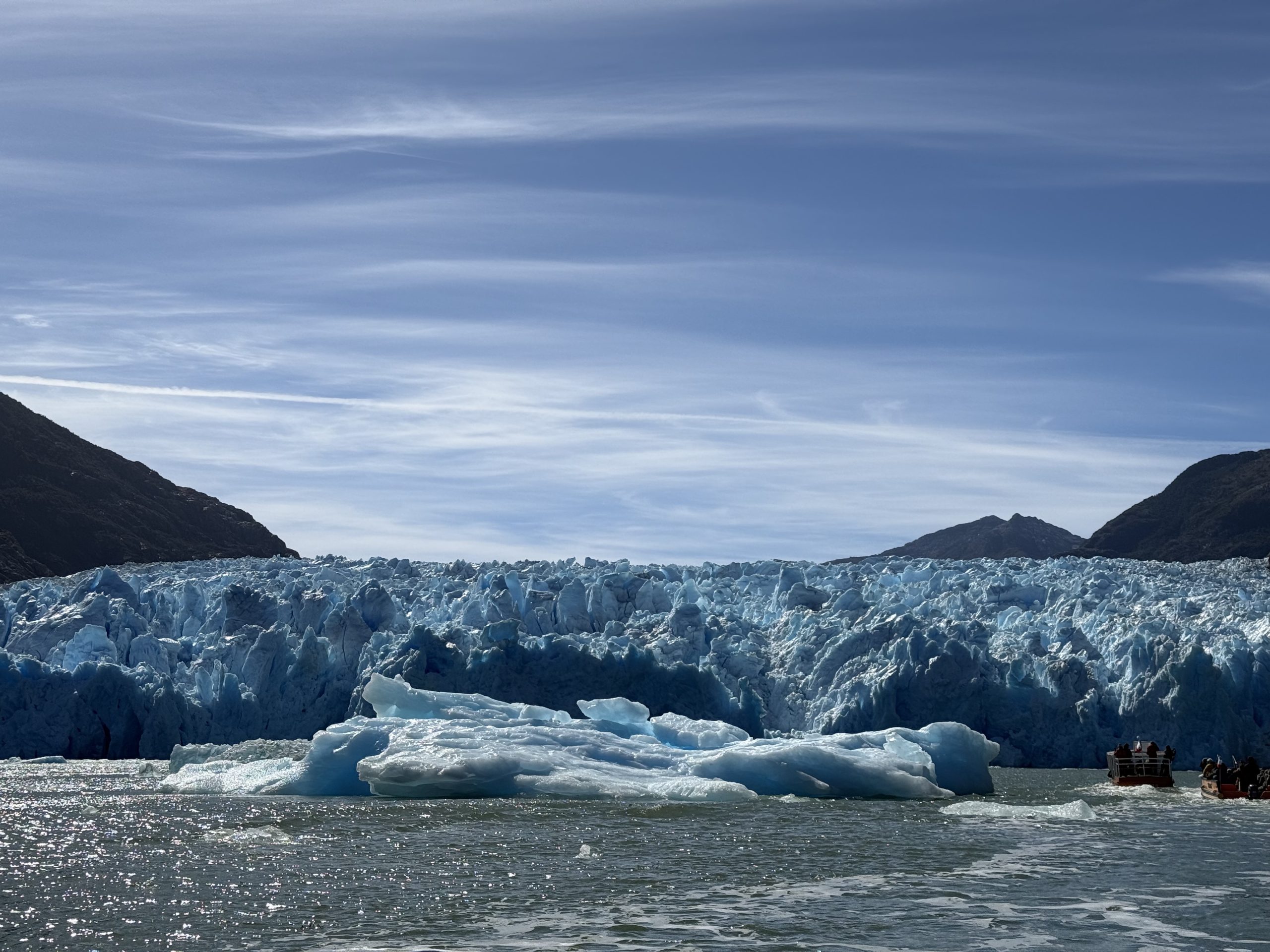
The 26th of January — Australia Day — turned out to be the day we reached San Rafael Glacier, and it proved an occasion worth marking.
As the ship paused to lower the tender, two dolphins appeared alongside the hull and began to frolic. I am not generally inclined to read significance into animal behaviour, but it was genuinely difficult not to feel welcomed. Nature, as I noted in my diary at the time, throws the best parties.
We tendered out on the Explorer II into a lake filling with icebergs — small ones and very much not-small ones — all of them that distinctive blue that ancient ice acquires, carved and cratered by water and wind into forms that resemble nothing so much as abstract sculpture. The glacier itself rises at the far end, vast and white and rather lordly.
Then the calving started.
Chunks of 30,000-year-old ice — let that figure settle for a moment — began cracking away from the glacier’s face and tumbling into the water. The sound arrives a beat after the sight: a deep crack, then a rumble, then the splash. Seabirds lifted off in response. A sea lion sunbathing on a flat iceberg surveyed the drama with complete composure. Another swam in circles and slid off the edge.
The ship’s crew drew alongside a particularly photogenic iceberg and hacked off a large lump of crystal clear ice. A twelve-year-old Scotch was produced. We drank it from the glacier’s own water, with the glacier right there in front of us, which felt like the correct way to proceed.
Back on board: mulled wine, lunch, and the slightly dazed feeling of having witnessed something that will take some time to properly absorb. Waterfalls streaked down the rainforest behind the ice. Cormorants worked the surface. The afternoon was not, as I wrote at the time, over yet.
A country built on water
What the fjords teach you — slowly, over five days — is how much of Chile is water. Not just the coast, but the rivers and lakes, the glacial melt working its way down through every valley. The country runs vertically for 4,300 kilometres, which is a preposterous length, and along much of it water is the dominant fact of life. The Scorpios II moves through that fact at a comfortable pace, which turns out to be exactly the right speed.
By the time we reached the southern end of the cruise and prepared to fly further south still — to Punta Arenas and the Patagonian pampas — the scale of what we’d been moving through had begun to register properly. Chile, as I keep saying to anyone who’ll listen, is a country of extremes. The fjords are one kind of extreme: not the harsh inhospitability of the Atacama, but an extravagance of water, forest, and ancient ice that takes the breath away by sheer, quiet accumulation.
Next: The Patagonian pampas, a Scottish estancia, and the towers of Torres del Paine.