Chile: Ah, Patagonia!
The high pampas of southern Patagonia reminded me, immediately and unexpectedly, of home. Not the lush, subtropical home of southeast Queensland, but the older, drier home of the Darling Downs: flat country, big sky, occasional hills rising without particular justification from the plain. The grasses are a different gold. The animals are different animals. But there is something in the light, and in the sense of enormous horizontal distance, that produces the same feeling of exposure and freedom.
Instead of kangaroos and emu, there are guanacos and rhea — Patagonia’s version of the same ecological logic, it seems. And llamas. And Merino sheep, beautiful ones, because wool production still dominates down here, just as it did at home for much of the 19th and 20th centuries.
Dinner at the estancia
We drove through the high pampas one afternoon in late January, heading towards our hotel, and stopped for dinner at a working estancia — or what was, until recently, a working estancia. The property was established in the late 19th century by a family of Scottish immigrants who built a sheep farm and ran it through several generations of their descendants. More recently, the whole operation has been converted into an agri-tourist enterprise: you can ride across the pampas on horseback, stay in the hacienda, eat dinner in the old dining hall, and apparently the fly fishing is rather good.
The dinner was roast lamb on a spit with excellent Chilean wine, which is exactly the right meal for that landscape. What caught my attention were the objects on the shelves around the dining hall: relics of the farming operation, yes, but also books. Old books, clearly read, belonging to a family across successive generations in this improbable location at the bottom of the world. I found myself thinking about those Scottish-Chilean readers — what they made of the pampas, what they thought when they looked out the window at a landscape so unlike anything their forebears had known, whether they ever stopped finding it extraordinary.
We left as the moon rose over the hills. A couple of llamas were looking very contented with their lot.
Torres del Paine
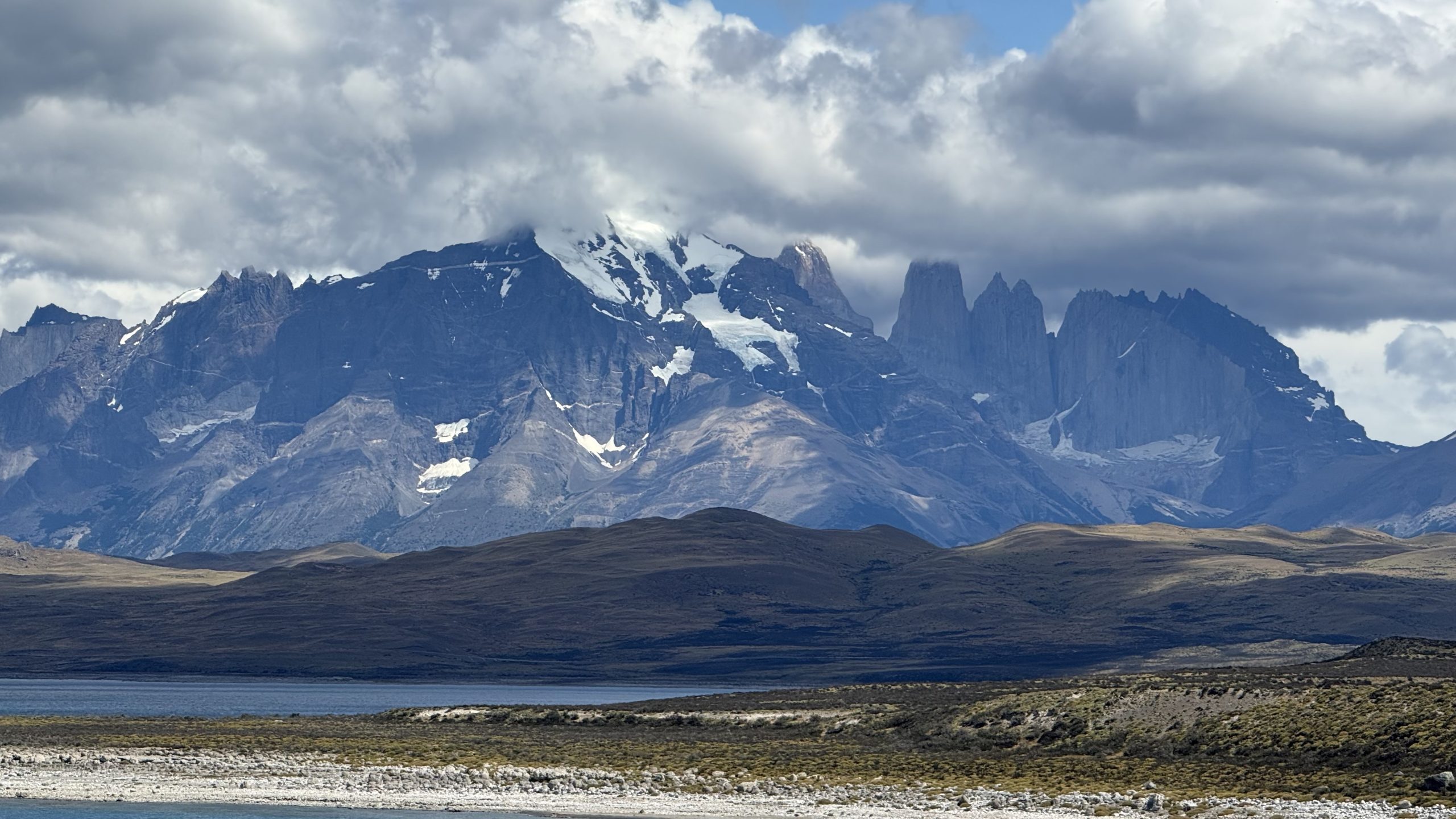
If the Atacama is Chile’s most extreme landscape in one direction, Torres del Paine is its most extreme in another. This is what the end of the continental landmass looks like when it hasn’t yet decided to stop producing drama: granite towers rising nearly 3,000 metres from the surrounding terrain, glaciers descending from the Southern Patagonian Ice Field, weather systems arriving from the Pacific and behaving however they please.
I walked in those landscapes for several days. The light shifts constantly — cloud moving across the towers, then clearing, then returning. The colours in the surrounding vegetation are extraordinary: calafate berries in deep purple, grasses in shades from pale gold to russet, the blue-grey of the glacial lakes. There are condors here too, and foxes, and the ubiquitous guanacos watching you with mild scepticism from the hillside.
On my last morning, I sat in my room at the Hotel Serrano and watched the clouds clear from the three towers. I’d been looking at them for several days and they still produced, each time, a small intake of breath. The landscape is simply unlike anything I’ve encountered before — and I’ve been fortunate enough to encounter quite a few landscapes.
On keeping a diary
I mentioned in my travel diary that I was glad to have kept daily notes, because the sequence of events on a trip like this can blur quickly. That’s true. But there’s another reason: the writing forces you to notice. When you know you’re going to have to describe something, you look at it more carefully. The condor in the Atacama, the dolphins by the glacier, the expression of comfortable indifference on the llama’s face as the moon came up — these details survive because they were written down while still sharp.
Chile is a country of extraordinary contrasts and extreme diversity. From the driest desert on Earth in the north to glaciers and granite towers in the south, it traverses climates, ecologies and histories that feel like different planets. Three weeks is enough to get a sense of its range — not nearly enough to understand it properly.
I came home with a head full of images and an expanded sense of how large and various the world remains. And a strong conviction that I’ll be back.
This was the final week of a three-week expedition to Chile and Patagonia, January–February 2026.